
How to Work With Tourism Boards
When I landed my very first partnership with a tourism board back in late 2021, I had no idea how much it would change the trajectory of my business.
It was a post-FAM trip connected to a conference, and while I was nervous at the time, I quickly realized how powerful these collaborations could be.
Since then, I’ve worked with over 30 tourism boards and those partnerships are what truly launched my blog into a business.
Today, freelancing for my local tourism boards makes up the majority of my income, something I never imagined when I first started.
The best part—I didn’t even have 5k followers when I started working with tourism boards.
If you’re a travel blogger or content creator who dreams of working with tourism boards, you might feel overwhelmed with questions.
Maybe you wonder if you need a huge following to get noticed, or what you should even say in a pitch. Or maybe you’re curious how to turn one short-term project into a lasting relationship.
In this guide, I’ll share everything I’ve learned about how to work with tourism boards, from building your media kit to landing your first collaboration and even handling rejection along the way.
Disclaimer: This post may contain affiliate links. If you make a purchase through this link, I may earn a small commission at no additional cost to you. See my Disclosure Policy for more information. Thanks for keeping Stuck On The Go going!
Are you a travel blogger who wants to work with tourism boards?
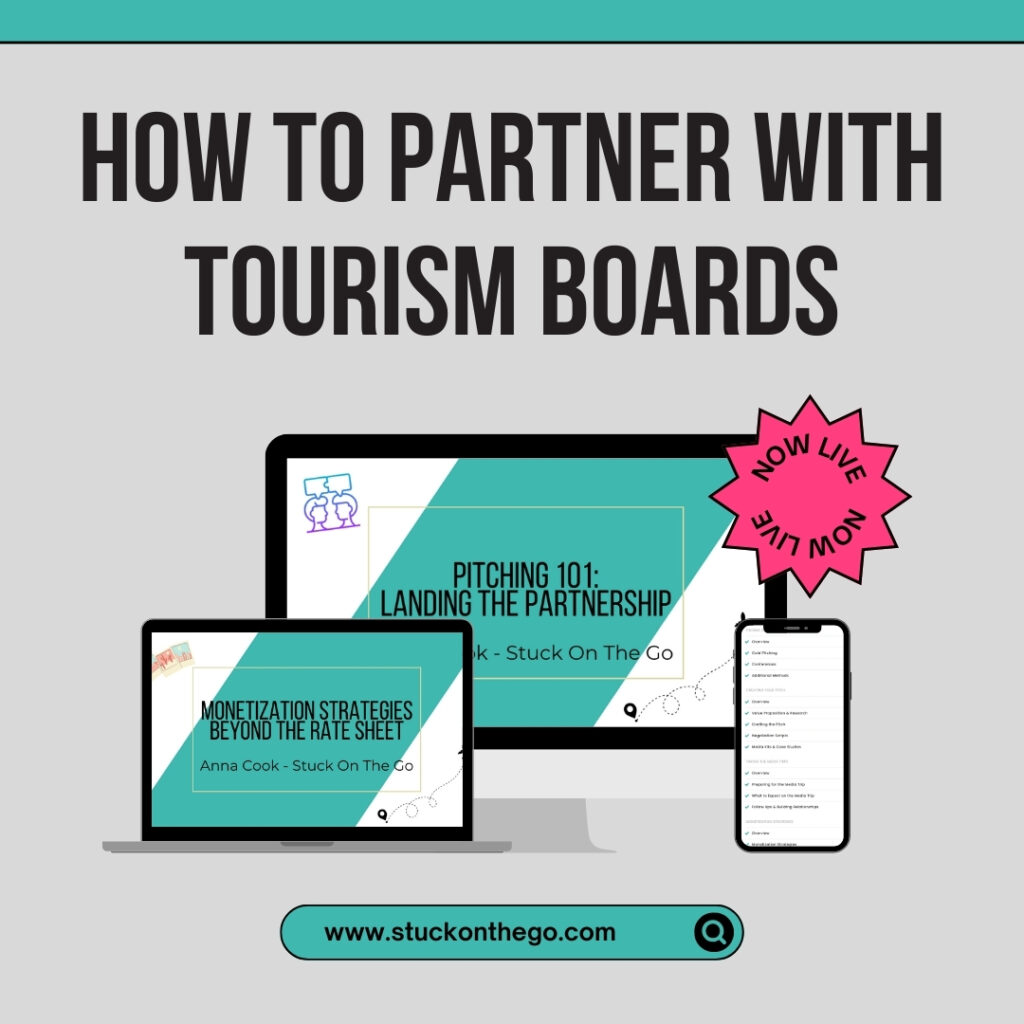
Check out How to Partner with Tourism Boards & Get Paid (Without a Massive Audience)
If you’re a travel blogger who feels overlooked by tourism boards, this course gives you the exact steps and proven strategies to land collaborations—without needing thousands of followers.
What is a Tourism Board?
Before you can learn how to work with a tourism board, it helps to understand what they actually do. A tourism board, also known as a Destination Marketing Organization (DMO), is responsible for promoting a specific city, region, or state to potential visitors.
Their main goal is to increase tourism by highlighting the best experiences, attractions, restaurants, and accommodations in their area.
Sometimes a tourism board is run by the local government, while others operate as independent entities. You may also hear them referred to as a Convention and Visitors Bureau (CVB).
Typically, they are funded through occupancy taxes that visitors pay when they stay in hotels or vacation rentals in the area the DMO manages. Some can also be member-funded or receive government funds depending on how they are set up.
Since occupancy taxes make up a large portion of their funding, (typically) their big goal is to attract travelers who are going to spend the night.
For travel bloggers and content creators, this creates a natural partnership opportunity. Tourism boards need engaging photos, videos, and written stories that showcase their region in an authentic way.
Creators want access to experiences and information that allow them to create high-quality content for their audiences.

Do You Need a High Follower Count to Work with Tourism Boards?
One of the biggest misconceptions I hear from new bloggers is they think you need at least 10k or more Instagram followers before a tourism board will even consider working with you. I’m living proof that isn’t true.
When I started working with tourism boards, I had just 1,500 followers on Instagram, fewer than 1,000 on Facebook, and my blog was getting between 10,000 and 15,000 monthly pageviews.
Those are not huge numbers by any stretch, yet I still landed collaborations that opened the door to long-term partnerships.
Now, does having a larger following make things easier? Absolutely. But follower count is only one piece of the puzzle.
It’s all about how you present yourself when you’re pitching. Instead of focusing on what you don’t have, emphasize what you bring to the table, whether that’s high-quality photography, strong SEO skills, or an engaged audience that trusts your recommendations.
I’ve also seen multiple friends with similar follower counts land successful partnerships. It’s not about being the biggest creator in the room, but about showing how you can support their marketing needs.
How to Connect with Destination Representatives
Landing partnerships with tourism boards starts with making the right connections, and in my experience, there are a few key ways to do that.
My personal favorite way is through conferences. If you can find a regional conference, that’s often the most effective because you’ll have access to DMOs from the areas you want to cover. Networking has been a big part of becoming a content creator for me.
Larger events like TBEX or WITS are also great opportunities to meet destination representatives face-to-face. However, I’ve found these are more lucrative for those with bigger followings.
There are some great travel blogging conferences to attend specifically for networking or some that include educational sessions.
Another approach is to connect directly with a tourism board once you’ve already created content about their destination.
If you’ve written a few blog posts or created some reels about the area, reach out to the marketing representative and share your work.
Don’t ask for anything in this first email. Simply introduce yourself, share the content you’ve already created, and let them know you’d love to stay in touch. This is an easy, no-pressure way to get on their radar.
You can also find virtual networking opportunities. The Creator Network, led by Hello Social Co. leads webinars with DMO representatives that are really helpful.
These sessions are not only educational but also a chance to connect directly with the people you may want to work with later on.
The bottom line is this: any opportunity you have to network and get your name out there is worth taking. Tourism boards are more likely to work with bloggers they already know and trust, so building those connections early makes a big difference.
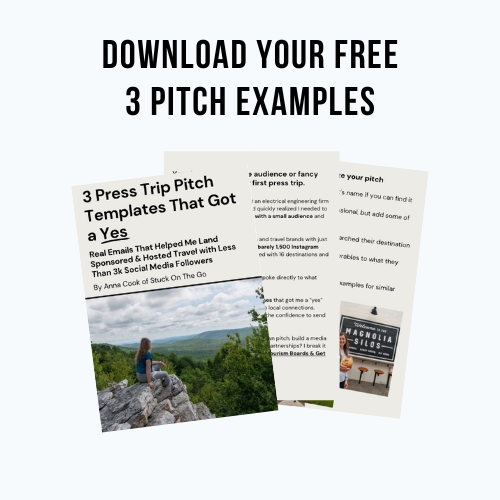
Struggling to land your first press trip?
These 3 real pitch examples show you what works and give you the confidence to send your next pitch without second-guessing every word.

Ways to Collaborate with a Tourism Board
There isn’t just one way to work with a tourism board. Thinking outside the box can often be the key to turning a one-time collaboration into a paid partnership. Here are a few different ways to work with tourism boards so you can start generating ideas.
Content on Your Own Channels
This is what most bloggers think of first: creating blog posts, social media content, YouTube videos, or newsletters that highlight a destination. Tourism boards love this because it introduces their location to your audience in an authentic way.
These collaborations can be structured as hosted trips (where expenses are covered) or sponsored campaigns (where you’re paid in addition to having costs covered).
User-Generated Content (UGC) for the Tourism Board
Another option is to create content specifically for the tourism board to use on their own platforms. This might mean providing photos, reels, or blog-style articles that they can publish on their website or social channels.
UGC is valuable because it gives DMOs professional-quality content without having to send someone in-house to capture it. This is also one of the easiest ways to turn a hosted trip into a paid project.
My first year working with DMOs, selling photos was the main way that I generated income, and I regularly write for my local tourism board.
Specialty Projects or Event Coverage
Some examples of creative projects that I’ve done in the past are putting together itineraries for destinations (blog and PDF), writing for their Visitor’s Guide, and helping to organize a group creator trip to the destination.
Tourism boards are always looking for fresh ways to market their destination, so bringing creative ideas to the table can set you apart.
If there is a specific event that your audience would love, you can also partner with the destination or the event itself to promote.

What Do Tourism Boards Look For
If you want to land collaborations, it helps to understand how tourism boards evaluate potential partners. At the end of the day, they are marketing organizations with specific goals, and they want to be sure your brand aligns with theirs.
The first thing they’ll look at is your niche. A tourism board wants to see that your content matches the type of experiences they’re promoting.
For example, if your niche is outdoor adventure and their region is known for hiking, that’s a natural fit. But if your focus is luxury travel and their destination is a budget-friendly small town, it may not be the best match.
They’ll also consider your audience demographics. If your readers or followers don’t match the type of traveler they want to attract, then the partnership won’t make sense no matter how strong your content is.
For instance, a destination looking to reach young families likely won’t prioritize a blogger whose audience is primarily solo millennial travelers.
Follower count does matter, but it’s not the whole picture. More important is your engagement and community trust.
Tourism boards want to know that when you share a recommendation, people actually pay attention and act on it. A smaller, engaged audience is often more valuable than a larger but passive one.
Another factor is content quality and professionalism. They’ll be looking at the tone of your writing, the quality of your photography or video, and whether your brand feels polished and trustworthy.
Finally, they consider existing relationships. Many tourism board representatives prefer to work with bloggers and influencers they’ve personally met at conferences, networking events, or through introductions.
Once you’re on their radar and they know you on a personal level, you’re much more likely to be considered for hosted or sponsored opportunities.
How to Pitch a Potential Partnership
Once you’ve identified a destination you’d love to work with, the next step is crafting a pitch that gets their attention.
This is where many creators go wrong, because they make the pitch all about themselves. Instead, your focus should always be on the destination and how you can help them reach their marketing goals.
The Pitch
A successful pitch is not about your follower count or everything you’ve accomplished as a creator. While those things matter, they shouldn’t be the spotlight of your email.
Your pitch should clearly demonstrate how you can help the tourism board showcase their destination and connect with their target audience.
I like to structure my pitches in four parts:
- Quick introduction – Just one or two sentences about who you are and what you do.
- Why you’re a good fit – Share why you want to work with this specific destination and what aspects you’d love to highlight. This makes your pitch feel personal rather than generic.
- Teaser of deliverables – Give a preview of what you could offer. These days, because I primarily do paid partnerships, I’ll often note that I can send a full proposal or tailor deliverables based on their budget.
- Next steps – Attach your media kit and ask if they’d like to hop on a call to discuss specifics. This keeps the conversation moving forward without overwhelming them with too much detail upfront.
When you pitch this way, you’re not just asking for a free trip, but you’re presenting yourself as a professional partner who can help them achieve their marketing objectives.
If you’re looking for inspiration on how to structure your outreach, this tourism board pitch template breaks down exactly what to include in each section of your email.
It’s good to note—I use a very similar formula for pitching hotels as a creator.
Need help with your pitches? Join my free Facebook group, Working with Tourism Boards as a Travel Blogger where I share advice on pitching and more.
Media Kits
A media kit is a little like a creator’s resume. It’s often the first impression a tourism board will have of you, so it needs to communicate your value quickly and clearly. Creating a media kit is one of the first things you should do before pitching.
If you don’t have a huge audience, don’t panic. Instead of centering your media kit around follower counts, highlight the metrics that matter most.
Share your engagement rate, your email open rates, or your blog’s monthly pageviews. If your audience demographics are really specific, whether that’s a specific niche or specific location, that’s also worth emphasizing.
For creators who want to lean into UGC work, a media kit can function more like a portfolio. In that case, focus less on numbers and more on showcasing the quality of your photography, videos, or writing.
Tourism boards want to see what your work looks like, so strong visuals or links to recent collaborations can often speak louder than raw stats.
A professional, well-designed media kit makes you look polished and credible, no matter what stage you’re at in your blogging journey.
Case Studies
Case studies were one of the biggest tools that helped me land partnerships when I was first starting out. They gave tourism boards concrete proof of the value I could provide, which made it much easier for them to say yes.
A strong case study should highlight the results of your past work. This can include things like the reach and engagement on social media posts, pageviews for blog posts, and email campaign stats if those were part of the collaboration.
You can also include qualitative proof, such as comments from readers saying they booked a trip because of your content or asking detailed questions about the destination you covered.
These kinds of interactions demonstrate influence in a way numbers alone can’t.
I love using InfluenceKit to put together my case studies. I used to gather all the stats manually and design a document in Canva, which was time-consuming.
InfluenceKit has saved me hours by pulling everything together automatically into a polished report. They give you one free report per month, which has been enough for me.
If you don’t have any past partnerships to build a case study from, build one from a trip that you paid for yourself. Just don’t present the case study as a “past partnership.” You can say it’s an example of your work.

What to Ask on a Discovery Call
Discovery calls aren’t required, but in my experience, they’ve been incredibly helpful in landing partnerships and making sure expectations are clear on both sides.
These conversations allow you to learn more about the tourism board’s goals while also clarifying the logistics of the collaboration. If you hate phone calls, you can always do this over email.
At a high level, you can ask questions like:
- What are your marketing goals for this partnership?
- What does a successful creator partnership look like to you?
It’s just as important to dig into the practical details. For example:
- How do you typically handle food expenses? What about tipping?
- Do you prefer to plan the itinerary, or should I build one that fits my content style?
- How do you handle transportation costs to the destination?
Don’t be afraid to “sound like a newbie.” I’ve worked with more than 30 tourism boards, and I can tell you that no two collaborations look exactly the same.
Every DMO handles things differently, so it’s always worth confirming the details up front.
What Does a Partnership Typically Look Like?
I’ve said this before, but it’s worth repeating: no two partnerships with tourism boards look exactly the same. That said, there are some common patterns you can expect when working with a DMO.
Most press trips are at least three days and two nights, and you should be prepared for a packed schedule.
Since the tourism board already has you there, they want to showcase as much as possible in a short amount of time. That often means early mornings, full days, and little downtime.
The experience will also differ depending on whether it’s a group press trip or an individual trip.
Personally, I prefer individual trips because they give me more control over the itinerary. On those trips, I typically focus on outdoor adventures and locally-owned food and drink spots since that’s the heart of my brand.
On a group trip, you have less say, and the itinerary is designed to fit a wide variety of creators. I only accept group trips when they are highly relevant to my niche.
No matter what type of trip it is, you’ll usually meet with the destination representative at least once, often over a meal. This is a great chance to strengthen your relationship and ask any clarifying questions.
A few other things to keep in mind: sometimes communication with attractions or restaurants isn’t perfect.
Don’t be surprised if staff don’t know who you are when you arrive—it happens often. I like to ask my DMO rep ahead of time if there are specific people I should connect with at each stop.
I also recommend printing out your itinerary before the trip. That way, if your rep doesn’t provide a hard copy, you’ll still have one to reference. I often take quick notes on mine so I can keep track of details.
Whether you use a notebook or your phone, make sure to jot things down. You’ll be given a lot of information in a short time, and staying attentive will make your content stronger later.

Hosted vs. Sponsored Collaborations
When you’re working with tourism boards, you’ll often hear about two main types of partnerships: hosted trips and sponsored trips.
A hosted trip typically covers your travel expenses, including accommodations, meals, activities, and sometimes transportation to the destination.
In many cases, there are few or no required deliverables, though some destinations may request a blog post or social media coverage. These trips are a great way to build your portfolio and experience, especially when you’re just starting out.
A sponsored trip includes all the benefits of a hosted trip, but with one major difference: you’re also paid for your work.
Sponsored trips usually come with clearly defined deliverables, such as a set number of blog posts, reels, or images. Because there’s payment involved, both sides agree upfront on exactly what will be delivered.
When you’re first getting started, you’ll likely accept some hosted trips. I still do from time to time if it’s a bucket list destination or if the trip aligns perfectly with my content.
But I always weigh the value carefully. Being out of the office has an opportunity cost, so a hosted trip needs to offer something significant in return.
As you build a track record and can show proven value through case studies and past partnerships, it becomes much easier to shift toward sponsored collaborations.
That said, it’s worth noting that sponsored trips can be harder to land with a smaller audience unless you bring a specialized skill like photography, videography, or UGC creation to the table.
Building Relationships for Long-Term Partnerships
If I had to pick one strategy that’s made the biggest difference in my business, it would be building strong relationships with tourism board representatives.
It’s so much easier to pitch when you already have a connection, and many DMOs prefer to work with creators they’ve partnered with before. When paid opportunities come up, they often reach out to people they already know and trust.
A simple but effective way to strengthen these relationships is by following up after your trip.
Send a recap email with analytics from your campaign so they can clearly see the value you provided. This not only shows professionalism but also keeps you top of mind for future opportunities.
Staying in touch is equally important. Conferences are one of my favorite places to reconnect with DMO reps I’ve worked with in the past, but you don’t have to wait for a big event.
If you publish another piece of content about their destination, especially one that performs well, send it to them. Even small gestures, like forwarding an article you found about their destination and sharing your excitement, show genuine interest and help you stand out.
Some creators go a step further by sending small gifts around the holidays. I haven’t done gifts myself, but I have sent cards to people I work with regularly. These little touches keep the relationship warm and personal.
One of the most impactful ways I’ve built long-term partnerships has been through my local DMOs. For the past year, I’ve freelanced for several of them, creating content and positioning myself as a local resource.
This has changed the trajectory of my business. Freelancing for local tourism boards now makes up a significant portion of my income and has created consistent, reliable work.
Building strong relationships takes effort, but it’s one of the best investments you can make. Not only does it lead to repeat opportunities, but it also positions you as someone destinations can count on for the long term.
How to Handle Nerves and Rejection
Pitching tourism boards can feel intimidating at first, but the best way I’ve found to handle nerves is by reframing the situation.
I remind myself that the worst thing that can happen is they say no. That’s it. On the other hand, the best thing that can happen is I get paid to visit a destination I’m excited about and create content I love.
For me, that trade-off is always worth taking the chance.
If you’re really nervous, have a friend look over your pitch before you send it. Sometimes a second set of eyes can give you confidence that you’re presenting yourself clearly and professionally.
I run the Facebook group, Working with Tourism Boards as a Travel Blogger and you can always join and ask for feedback in there.
When it comes to rejection, one of the most important things is not to take it personally. I know that’s easier said than done, but rejection doesn’t always mean your content isn’t good enough.
More often than not, it simply isn’t the right fit at the right time. The destination may already have a full calendar, a limited budget, or a different audience they’re prioritizing. There are countless factors outside of your control.
The key is to keep pitching, keep refining your approach, and remember that every no is one step closer to a yes. I still get nervous when pitching, so even though the feeling may not go away, it does get easier because you learn how to manage it.
If you need a clear road map on how to work with tourism boards, especially as a smaller creator, my course may be for you.
Are you a travel blogger who wants to work with tourism boards?
Check out How to Partner with Tourism Boards & Get Paid (Without a Massive Audience)
If you’re a travel blogger who feels overlooked by tourism boards, this course gives you the exact steps and proven strategies to land collaborations—without needing thousands of followers.

